05 Dec Week 3: Honey Harvest!
Easily the best thing we’ve been gotten to experience so far at the farm: harvesting honey from the 4 bee hives kept on the farm.
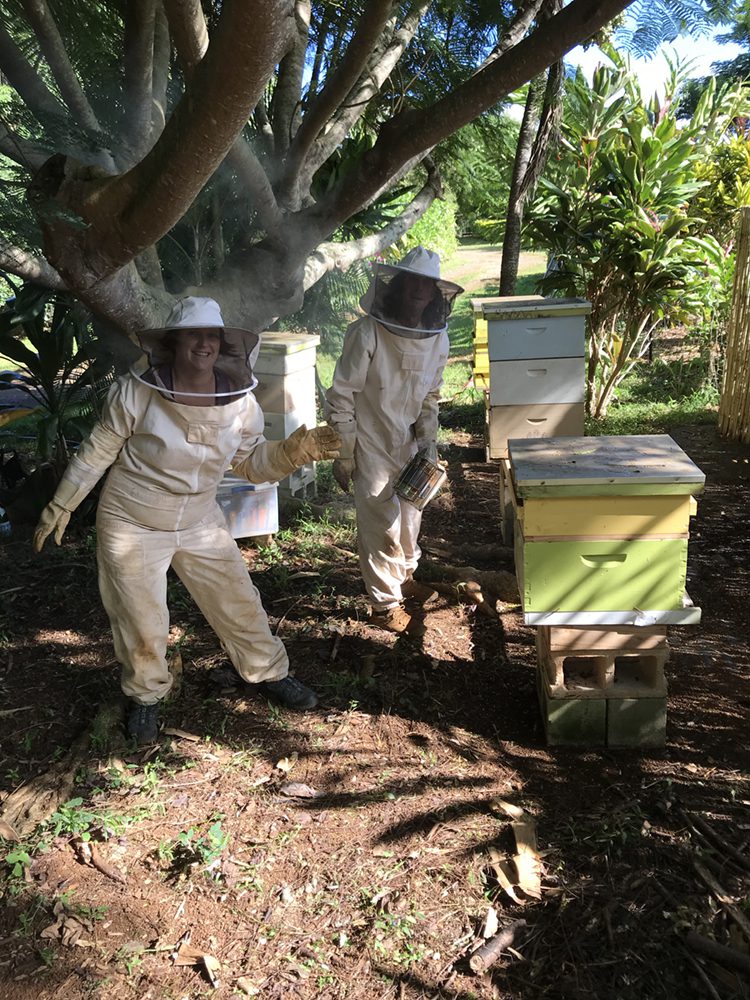
Wednesday late morning we donned the bee suits, sturdy shoes / boots & gloves late morning while the majority of the bees would be away from the hives out scouting. There will still PLENTY buzzing around!
We filled the smoker with kindling and prepared empty rubbermaid tubs with lids to store the honey-filled frames, as well as readied empty frames to replaced those we removed. The smoke would help mellow the bees so we sent a few puffs into each hive, leaving it closed, before we attempted any removal.
The frames need to be slowly pried out, as the wax builds up between them and makes them almost completely stuck to the outer casing. This is when the bees reeeeally start buzzing! We’re taking their life juice. Once the frame has been unstuck we quickly life, brush the bees off with a nice soft brush, then move it into a rubbermaid and close the lid. ANYTHING with honey in this area will attract bees, including the suit!
Video: Extracting the frame — Sound UP for bee buzzing!
We removed 22 frames total, replaced all of them with empty frames, leaving probably 3x that many frames in the hives still full of honey. The hives themselves weigh roughly 100 lbs or more, and an individual frame can be weighed down with as much as 20-30 lbs of honey!
The first few frames went very easily, but the longer we were there messing with the bees the more buzzy they get around our suits. Jiva taught us an important trick for deterring persistent bees: they won’t follow you through obstacles — so when feeling swarmed with bees, head to bushes, low-hanging branches, etc to help “brush” them off your suit / body. Worked like a charm several times!
Unfortunately, aaron’s suit was a little too tight, and was stretched over his shoulders and sometimes even his face when bending and moving around. He also had non-bee gloves on, that quickly became honey saturated (my fault: I tried to brush the bees off his gloves with the brush, and the brush was covered with honey! Leaving his non-bee-proof gloves covered with honey). The result was about 4 stings pretty quickly on his hands. He left to change gloves while Jiva and I continued working on removing frames.
Opposite of Aaron, I felt very impervious in my bee suit, and though the bees were swarming my face net, and really everywhere, I did not feel the need to panic or try to get them off me. I had the bottom of the pants tucked over my hiking boots and thus not a single milimeter of my skin was exposed. Even Jiva got a couple stings on his ankles through thick socks, in the 1″ gap between his pant legs & shoes!
After Aaron returned with fresh gloves, the bees were still relentless. While attempting to close up the final hive, he was stung on the lip through his net — and came a running yelling “help!” because the stinger was still lodged. Ouch! I quickly pinched the stinger out and we lost the trailing, angry bees by walking to other areas of the farm, and slowly removing our honey-spotted bee suits.
Luckily Aaron got baking soda immediately on all his bites, and iced them, as well as taking a Benadryl every 4-6 hrs for the first couple days to keep the swelling down. Rough experience for him, but all is well & almost healed 3 days later.
The whole removal process took about 90 minutes!
Honey Extraction – next day
Thursday we got to partake in the honey extraction — definitely the best part of the whole honey harvest.
We brought the storage tubs HEAVY with honey-filled frames into the house to begin the extraction. First we took each frame out individually, brushing off any “honey-drunk” bees that might remain inside, and set over a tub (the frames continually drip honey) for a slice & scrape to open up the combs. This helps the honey to flow easily out of the frames when we place the into a centrifuge.
Pro tip: keep the knife in a bath of hot water for easy cutting!
Jiva is an excellent teacher, letting us get hands-on with every step of the process!
After both sides of the frame are opened open, they are placed in a centrifuge so we can spin the honey outwards, one side at a time, with four frames inside.
Flipping the frames to extract the other side
After extracting both sides, we remove the frames to check for any unopened cells of the comb – and poke those clear or – in some cases of super thick frames – remove an entire layer of empty honey comb to expose a second layer underneath! After we’re sure the frames are empty we move onto another set until the centrifuge is too full to carry on (took 8 frames).
Then — the part we’ve all been waiting for — straining the honey for the final product!


Lindsey
Posted at 06:49h, 06 DecemberThis is the sort of long form format I need!! Love all the videos – how fascinating and cool to be pet of the process start to finish! (And sorry you got all stung up Aaron!)